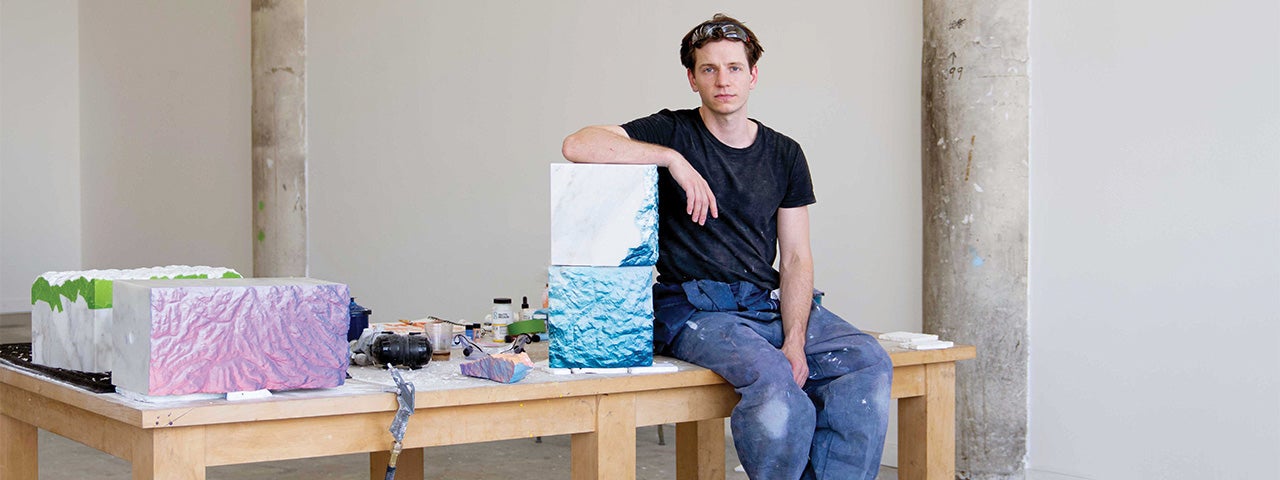
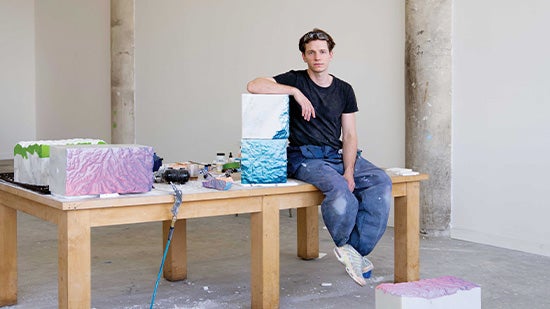
 Ruben Benjamin is a Munich-based artist whose growing international profile has taken him around the world. Earlier this year, he celebrated his first solo exhibition After the Dust Settles at Gallery Sonder in California.


One To Watch
Ruben Benjamin is a Munich-based artist whose growing international profile has taken him around the world. Earlier this year, he celebrated his first solo exhibition After the Dust Settles at Gallery Sonder in California.
First and foremost, your artworks are incredibly colourful. How would you describe your relationship to colour?
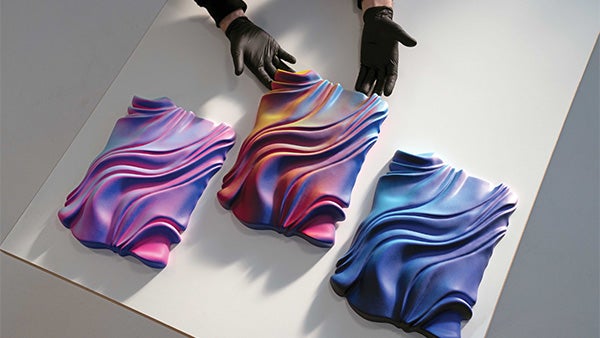
For me, colour is primarily a way of creating light, atmosphere and emotion. A lot of my inspiration comes from natural phenomena such as water, clouds, polar lights, atmospheric conditions or even microscopic images of plant structures. Nature produces colour combinations that often feel both surprising and completely natural at the same time.
Even when a work is completely static, I want it to feel as if something is shifting, reflecting or glowing beneath the surface. That's probably why colour remains one of the most important elements of my work. It's not only what people see first, but often what they feel first.
Your work, particularly recent series such as FRACTURED, exists somewhere between painting and sculpture. At what point did you realise you wanted to blur those boundaries?
I never consciously decided to blur the boundary between painting and sculpture. It happened naturally through my curiosity about materials and how they interact with light. I build up layers over time, adding pigment, texture and depth until the surface begins to create its own sense of light and atmosphere. With the FRACTURED sculptures, I became interested in the opposite approach. I start with a perfect geometric form, such as a cube, cylinder or triangle, and then remove material. The forms emerge through breaking, carving and exposing what lies beneath. There is a tension between the precision of geometry and the unpredictability of the fractured surfaces. What fascinates me is that both approaches are ultimately exploring the same question: how order and chaos can exist within the same object.
You have a background in mechanical engineering, having studied at the Technical University in Munich. How has that influenced your approach to art?
Art actually came first. Creativity was always a natural part of my life. Engineering simply gave me another lens through which to look at the world. What my studies taught me was a deep appreciation for materials, forces, structure and light. I became fascinated by how different materials behave, how they age, how they respond to stress, and how they interact with their environment. I still carry that curiosity into the studio today.
Your pieces are incredibly tactile and layered. Could you walk us through your creative process from initial idea to finished piece?
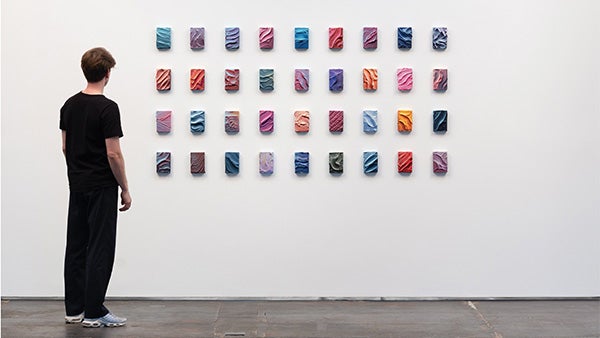
It's a balance between planning and chance. My studio walls are filled with small studies that act as sketches for larger works. They help me explore movement, colour and composition before I commit to a larger piece. Once I begin working, intuition takes over. My works are built through countless layers of wood, marble dust, water, pigments, acrylic paint and masking techniques. With so many materials interacting, it's impossible to predict every outcome.
What role does experimentation play in your studio?
I'm constantly testing new materials, techniques and ideas. A large percentage of those experiments never become finished pieces. Sometimes a material doesn’t interest me as much as I expected, and sometimes I simply can't translate my visual language into it in a convincing way. But I see that process as essential. Many of the ideas that eventually become important start as tests, mistakes or unexpected accidents in the studio. I enjoy working with materials I don’t fully understand yet. Whether it's aluminium, marble, new manufacturing processes or emerging technologies, I’m interested in pushing into unfamiliar territory.
How do you choose the materials you work with?
I’m mainly interested in how light behaves on different materials. In my textured works, I often combine very fine lines and subtle movements with larger, more confident gestures. The surface becomes important because light breaks differently across every ridge, layer and mark. Aluminium is especially exciting for me – it is a very hard, industrial material, but once painted, the colour can appear surprisingly soft. Marble interests me for a different reason – it absorbs light, but it can also seem to glow from within because of its crystalline structure. That quality is fascinating to me.
Your artworks have some interesting names – how do you choose the titles?
I collect fragments of language in everyday life: things I overhear at an airport, a sentence from a conversation at the next table, lyrics, texts or thoughts that stay with me. I’m often drawn to half-sentences because they leave room for interpretation. They can be poetic, slightly absurd or carry a sense of humour. For me, a title is not just a label; it gives the artwork a certain personality without explaining it too much.
What materials are you eager to experiment with in the future?
I’m in the final stages of a new series on aluminium. It took several months to resolve the various technical challenges, especially because I wanted to use acrylic pigments on aluminium in a very specific way. Getting the paint to adhere properly, while also working with masked areas and visible parts of the metal, was much more complex than it might look.
I also want to experiment more with sculpture this year, especially with objects made from black sand. It is an incredibly elegant material because it is so matte. My work is often about creating luminosity, so working with a material that absorbs light rather than reflects it opens up a completely different conversation.
How does it feel to see your work become increasingly recognised internationally?
For me, international recognition is less about visibility and more about dialogue. It creates opportunities to meet new people, discover different perspectives and place the work in new contexts. At the same time, I still feel very much at the beginning. Every project opens new questions, and that curiosity is probably what keeps me motivated most.
Image Credit: Ruben Benjamin