 Meet the man who’s shaping tailoring in the Lebanese capital


BESPOKE IN BEIRUT
Meet the man who’s shaping tailoring in the Lebanese capital
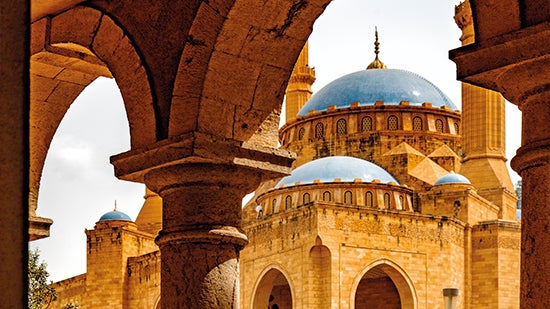
There is something undeniably cinematic about Beirut. The evening sunlight that slants off the sea and hits the corniche seems too rich not to have been designed. The great staircases of Achrafieh, draped in Bougainvillea and Jacaranda, appear built to host turning points in some narrative or another. Even navigating the city’s ubiquitous traffic jams can feel like watching a slice-of-life vignette. Fitting then, that one of Beirut’s most original costume designers should have an eye on cinema.
Ali Jaber is the brains and the eye behind bespoke tailoring house Syllogos Beirut. He also lectures in philosophy and film, and it was while studying for his thesis that he woke to the power of fine tailoring. “I was always in love with Cary Grant and the well-dressed actors of his era,” he says. Jaber began to commission local tailors to make pieces for him inspired by that golden era of style. It was a dalliance that quickly snowballed into an obsession and, as his relationship with the tailors deepened, he saw that they were struggling.
“Many of the tailors I was going to at the time had very little business, and I came up with the idea of a kind of social enterprise,” he says. The idea became Syllogos Beirut. Derived from the ancient Greek word for a gathering or assembly, Syllogos Beirut is a meeting of Jaber’s knowledge and aesthetic with the craft of some of Beirut’s oldest tailors. The artisans are paid a large cut of every commission, but Jaber is quick to point out this is no charity. “They are paid well because they are good at what they do and they understand the vision.”
The sartorial signature of Syllogos Beirut is the drape cut, which, according to Jaber, is nowadays only found in a few of London’s bespoke houses. Contrary to the modern taste for heavily waisted jackets and skinny trousers, the more generous drape cut flatters without restricting; essential if the clothes are to be worn in everyday life. “Ease of movement allows for elegance,” says Jaber. “The more comfortable you are inside the piece you are wearing, the less you will look fussed or self-conscious.
“We emphasise fabric and texture, and the designs are intended to be versatile. Less structured jackets that can convey formality while also working with a pair of jeans. Fuller trousers that create a balanced silhouette and allow for comfort in hotter climates. With a drape cut the fabric takes on a life of its own, it doesn’t cling to the body.”
A GOLDEN AGE
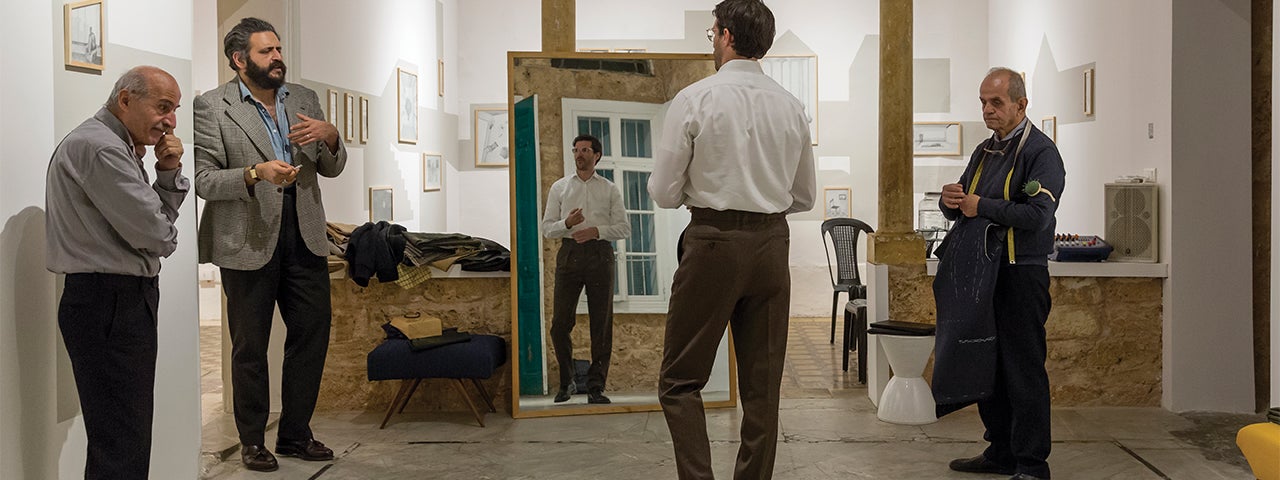
Syllogos Beirut’s master cutter and jacket maker is Antoine Abi Aboud. He has been a tailor all his life, starting an apprenticeship in 1970 and opening his own shop in 1977. Just a couple of years ago he was scraping by doing a few alterations, a jacket or pair of trousers here and there. Now he says he’s busy every day with around 70 per cent of his commissions coming via Syllogos. He still works from the same shop that he opened in ’77, tucked into a side street off a side street in the vibrant suburb of Ain el Remmaneh, which translates from Arabic to the “spring of the pomegranate”.
“The ’70s were a golden era for tailoring in Beirut,” says Abi Aboud. “We used to work so hard that we would make up beds out of bolts of fabric and sleep in the workshop.” The civil war that began in 1975 restricted the tailors’ work as much as it did any other profession, but actually pulled money into Lebanon and demand was resilient. During the postwar boom of the 1990s, a great deal of financing flowed into Lebanon from the Gulf, and with it came work. “Many clients came from the Gulf at that time,” says Abi Aboud. “They would arrive at the workshop in the morning, bringing the fabrics with them, and they would want a finished suit by the next day.”
It was in the early 2000s that demand began to drop off as tastes changed and people turned to fast fashion. At the same time, the economic liberalisation of Lebanon encouraged its youth to emigrate. Artisanal careers like tailoring, which were traditionally passed from father to son, were increasingly dismissed in favour of professions that opened doors abroad. “My children, for example,” says Abi Aboud, “they all travelled. There was more money to be made abroad. But now they tell me they wished they had learned the craft. I feel that people are gradually turning back to artisanship as they look for something unique.”
EVOLVING STYLES
A tall, somewhat imposing figure, impeccably suited whether delivering a lecture or playing backgammon in a street cafe, Jaber considers himself an evangelist for bespoke tailoring in an era where many have resigned it to boardrooms and wedding halls. He does no marketing for the brand, and yet it continues to go from strength to strength. “Most of my new clients are referrals from previous clients,” he explains. “People see something that’s hard to put your finger on, but it’s all in the particularities of the cut.”
For those clients, many of whom are new to buying bespoke, the process and its intimate connection to the city is also an attractive factor. David Höhn, an academic and lecturer from Germany, had never had any tailored clothes before he came across Syllogos. Now, he says he’s “stopped counting” the number of pieces he has commissioned. “I like the freedom of choice,” he says. “But I also enjoy the discussion, meeting the tailors, having coffee with them. It’s a kind of ceremony; quite a beautiful ritual.”
Although the majority of Syllogos Beirut’s clients are men, increasingly orders are coming in from women too. On a recent evening, Soledad André arrived to collect a finished trouser suit from the Syllogos Beirut showroom, a converted 1920s family house in the Ottoman style on the edge of the Downtown district. “It’s my first suit!” exclaimed André, an NGO employee originally from Martinique. “It’s something a bit new to my style, but it represents a memory of a moment, a city, a person. It’s something that maybe my grandkids will wear some day.”
Women’s high fashion in Lebanon in 2025 also blends bold glamour with cultural influences. Designers like Elie Saab, Zuhair Murad and Georges Chakra dominate with intricate couture, featuring plunging necklines, embellished gowns and vibrant fabrics. Beirut’s style is cosmopolitan, with women favouring elegant, form-fitting outfits, high heels and statement accessories. Traditional elements like embroidery are fused with modern cuts, reflecting Lebanon’s heritage. In this cultural and historical gateway to the East, modest and revealing styles coexist, shaped by Lebanon’s diverse, pluralistic society.
BRIGHT FUTURES
As Lebanon tentatively emerges from a troubled half-decade which saw its economy collapse, Beirut is regaining its lustre. Cafes and restaurants are opening at a dizzying speed; so fast that walking through a neighbourhood that one hasn’t visited for a few weeks can be disorienting. The streets of Gemmayze and Mar Mikhael buzz with life every evening, and for the first time in years people hold a cautious faith for the future.
Syllogos Beirut is already experiencing the benefits of this resurgence with orders for both men and women spiking. As the city’s chaotic but often beautiful streets fill with visitors and returning Lebanese ex-pats, Jaber is also making plans further afield. “I would like to take the brand to trunk shows in Europe and introduce the idea of Lebanese tailoring to that market.” If expansion is on the cards, he says it won’t be at the cost of exclusivity or the soul of the brand. Of course, one of the main motivations to go bespoke is to be able to express one’s own ideas; the “freedom of choice” that Höhn references. But every freedom has its limits.
“I’ve said no a few times to commissions,” he explains. “When clients have asked for things that I don’t want the brand to be associated with. I’m still promoting a certain sartorial aesthetic in the end. This is not just any tailoring.”
Image Credit: Jacob Russell